CARDMANSHIP MAGAZINE · OCT 2026 · ISSUE 01[ English Edition ]
CAAN-nection
Effect
The numbers freely rolled on 3 dice by a spectator help the performer locate both the performer's card and the spectator's selected card.
Setup
- 3 regular dice
- A deck of cards
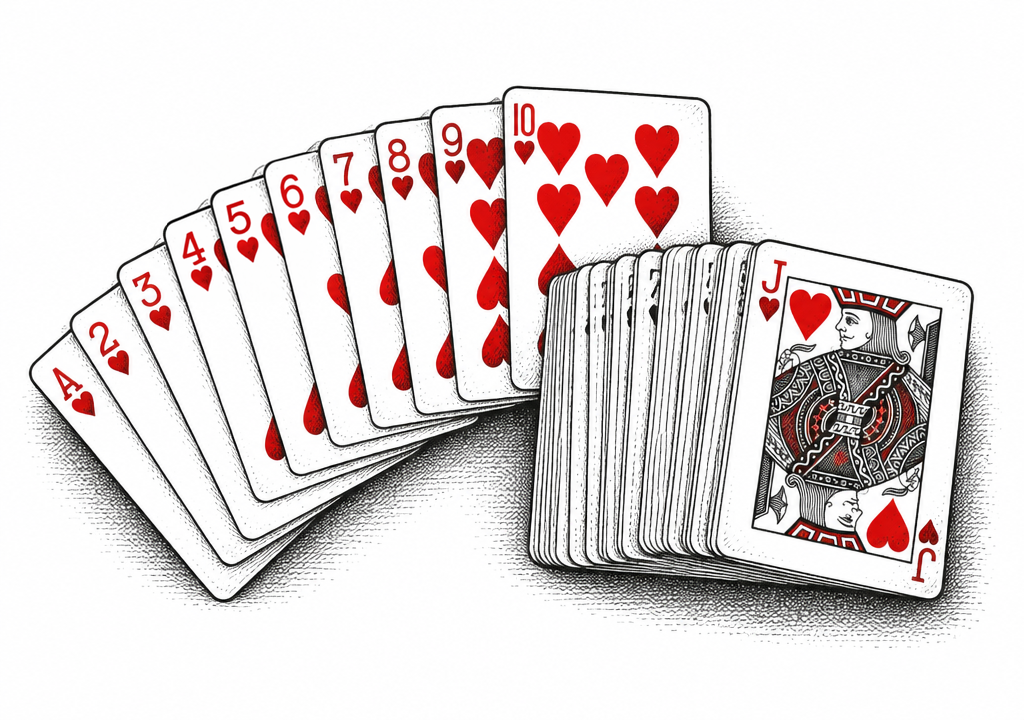
Remove the AH through 10H and place them on top of the deck. From top to bottom, the order is AH through 10H.
Performance
This routine takes advantage of the fact that the sum of the top and bottom faces of 3 dice is always 21, yet the number 21 is never directly mentioned during the performance.
False shuffle the deck, keeping the top stack intact. After shuffling, place the deck on the table and have the spectator cut off roughly half and hand it to you. Spread the cards face down between both hands, with the left hand pushing a large block of cards to the right first, retaining the stack in the right hand. Have the spectator select a card from the middle, trying your best to prevent them from picking from the stack.
While the spectator is memorizing their card, count 10 cards, holding a break under the 10H. Once they have memorized it, take back their selection and insert it into your break position. Square up the deck and give it a false shuffle. The spectator's selection is now at the 11th position.
Have the spectator pick up the remaining half on the table and shuffle it thoroughly. Select a card from their packet, pretend to memorize it, replace it, and let the spectator shuffle again.
After the spectator finishes shuffling, take back their packet and weave your packet and theirs together with an out-faro shuffle, ensuring that the top card of your packet remains the top card of the deck.
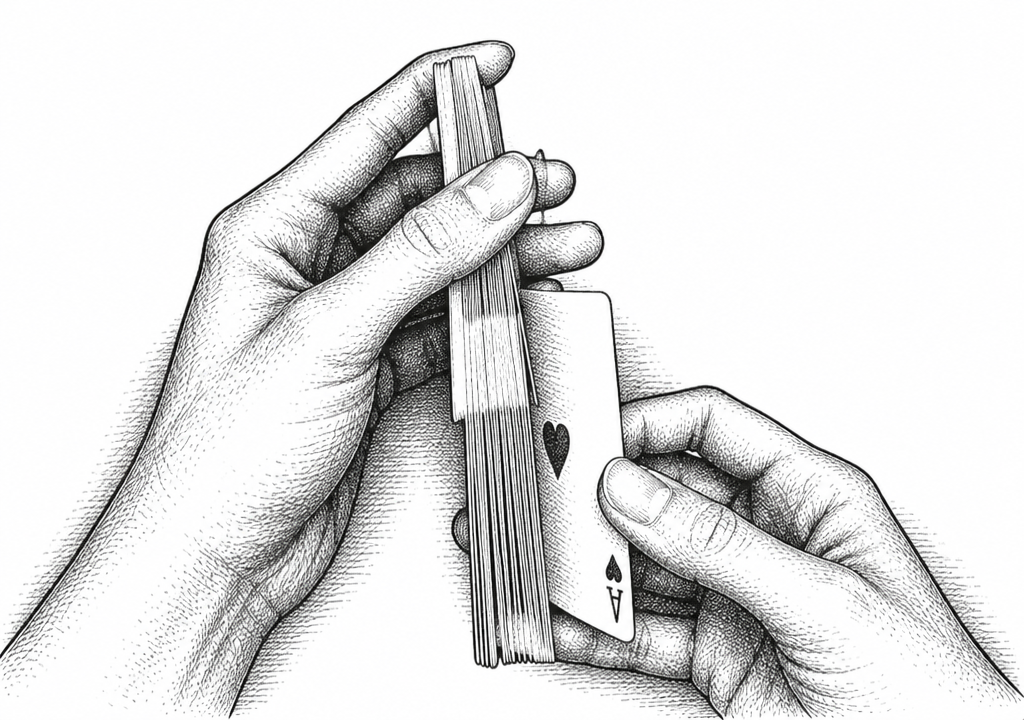
At this point, the spectator's selection will be at the 21st position, and all cards at odd positions will be from your stack: positions 1, 3, 5, and so on through 19.
Have the spectator pick up the 3 dice and roll them freely until they are satisfied. Observe the rolled sum.
If the Top Sum is Odd
Say: "The total of the dice you freely rolled will find my card."
Calculate the card at that position using the sum: add 1 and divide by 2. For example, if the sum is 11, the corresponding card is the 6H (11 + 1 = 12, and 12 ÷ 2 = 6). If the sum is 7, the corresponding card is the 4H (7 + 1 = 8, and 8 ÷ 2 = 4).
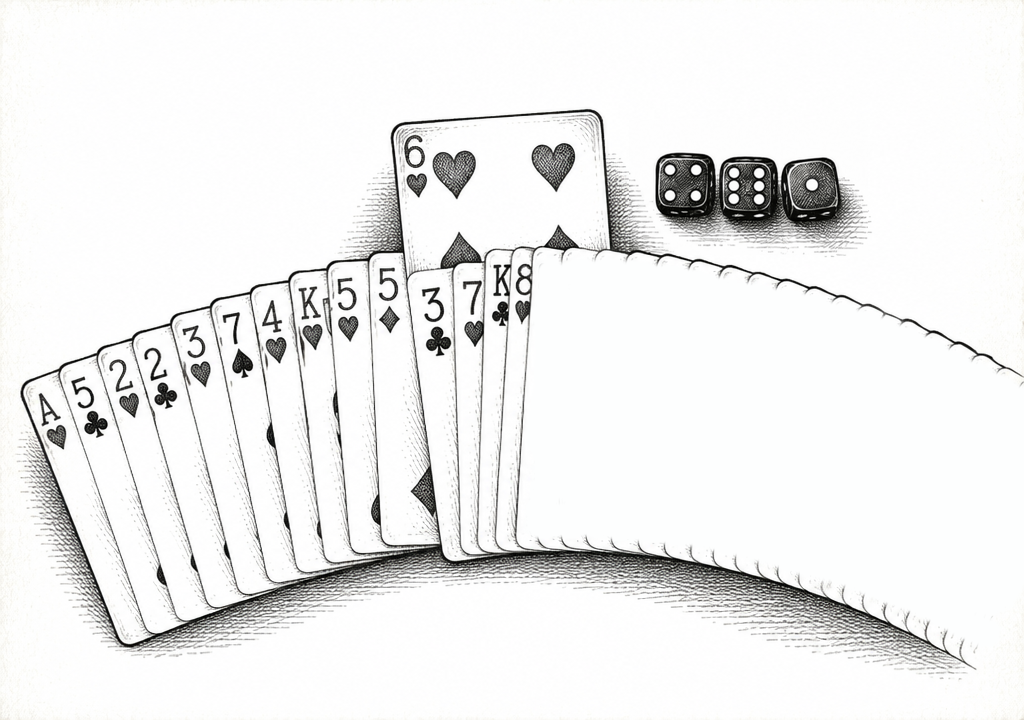
Name your card to the spectator and ask them to deal cards face down, one by one, to that number. Turn over that card to reveal your card.
Then tell the spectator: "The top faces of the dice found my card. Now let's look at the sum of the bottom faces. It should help find your card."
Turn all 3 dice over together, add up the numbers on the bottom faces, and have the spectator deal that many additional cards directly on top of the dealt pile. The last card they deal will be their selected card.
If the Top Sum is Even
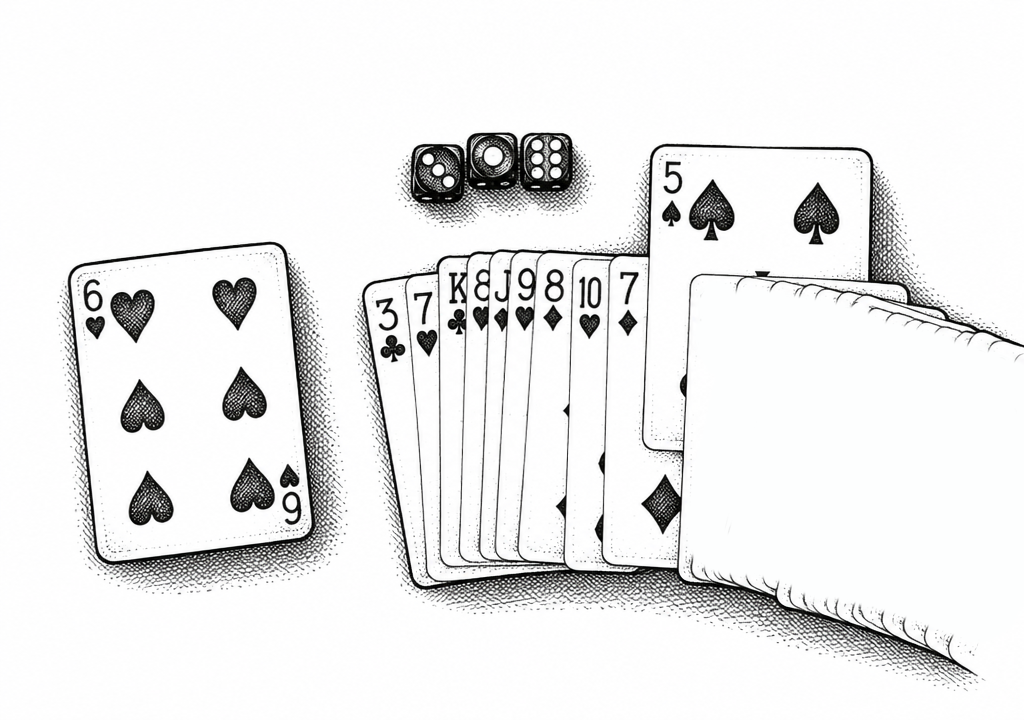
Say: "The sum of the numbers you freely rolled on top will help us find one card, and the bottom of the dice will find the other."
Turn the dice over to display the 3 numbers on the bottom and say: "Let's use the bottom numbers first."
Since the bottom sum is odd, calculate the corresponding card from the bottom sum. Name your card, and have the spectator deal down to that number to reveal it.
After finding your card, turn the dice back to their top faces and have the spectator deal that many additional cards. The last card will be their selected card.
Because the sum of the top and bottom faces of 3 dice is always 21, 1 side is always odd and the other is always even. You simply use the odd side first to find your card, and then use the even side to find the spectator's card.
Afterthought
Many dice-related tricks make use of the fact that opposite faces add up to 7. But these routines often reveal this fact too directly. In the routine I designed, the numbers on the top and bottom faces are calculated separately. No one can deny that these two numbers are genuinely produced at random, while the fact that opposite faces add up to 7 is never directly exposed to the spectators.
Campaña para el Número 2
Ayúdanos a alcanzar 2.000 seguidores
La revista Cardmanship es actualmente totalmente gratuita y sin anuncios. Cuando nuestro Instagram (@albertcardman) alcance los 2.000 seguidores, el Número 2 se publicará también de forma completamente gratuita.