CARDMANSHIP MAGAZINE · OCT 2026 · ISSUE 01[ English Edition ]
Undo 36 Divination
Effect
The performer brings out 2 packets of cards: a regular deck and a divination packet. Two spectators each cut the regular deck and remember the bottom card of the packet they cut off before replacing it. The performer then has 1 spectator choose a card from the divination packet. It turns out to be the very card they just remembered. The values of the remaining cards in the divination packet then add up to the position of the other spectator's selected card in the deck.
Setup
Prepare a regular deck. From top to bottom, the order is:
- 16 indifferent cards
- 1 Joker
- AH through 8H
- The remaining cards, with the second Joker about 30 cards from the top
Take another packet of 8 cards: AH through 8H. Its backs must have a different color or design from the regular deck. This is your divination packet.
Performance
Set the divination packet aside on the table.
Have the first spectator cut off about one-third of the deck and remember the bottom card of the cut packet. This ensures they cut into the sequence of Hearts. You can casually tell them not to cut off too much because a second spectator will cut next.
Next, have the second spectator cut about half of the remaining deck on the table and remember the bottom card of their packet. Make sure they cut past the second Joker so their packet includes it.
Have the first spectator replace their packet on top of the remaining cards on the table, then have the second spectator place their packet on top.
Say: "Good, so I have no idea what cards you remembered, right?"
Pick up the deck, turn it face up toward yourself, and say: "Wait, I forgot to remove the 2 Jokers. Let me take them out now."
Spread the cards face up toward yourself from the face (the original bottom of the deck) from left to right. The first Heart you see as you spread is the card the first spectator remembered. Note its value (let's assume it is the 7H).
Continue spreading until you reach the first Joker. Place it on the table. At the break where the Joker was removed, continue spreading while placing the packet in your right hand underneath the spread (Face-Up Undo).
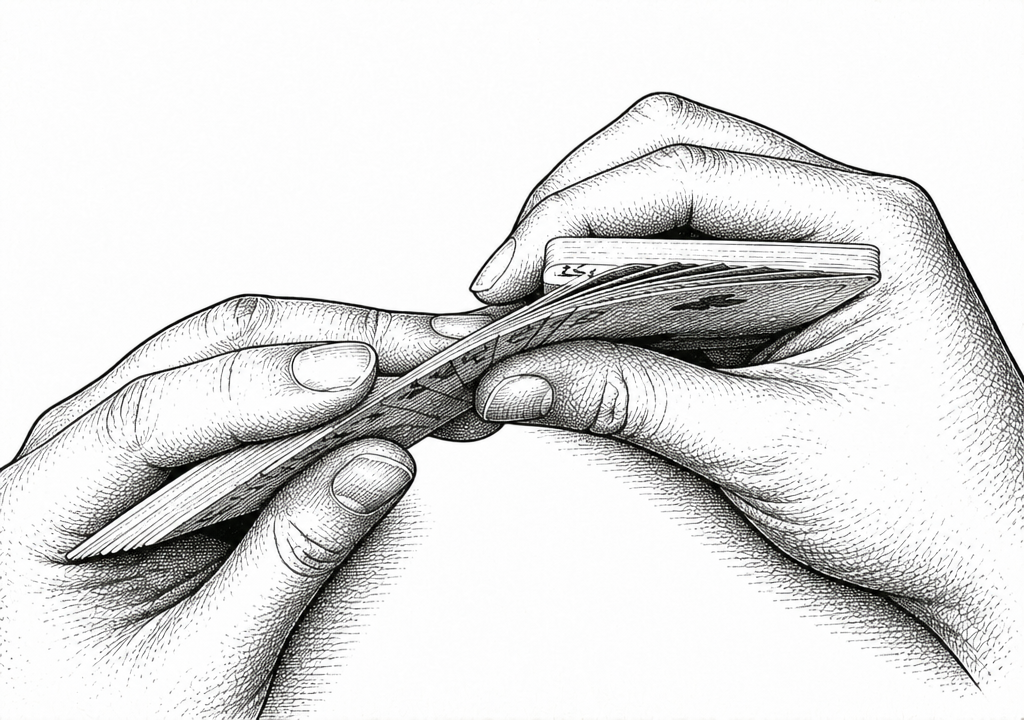
When you reach the second Joker, place it on the table. Continue spreading the cards, but this time place the packet in your right hand above the spread.
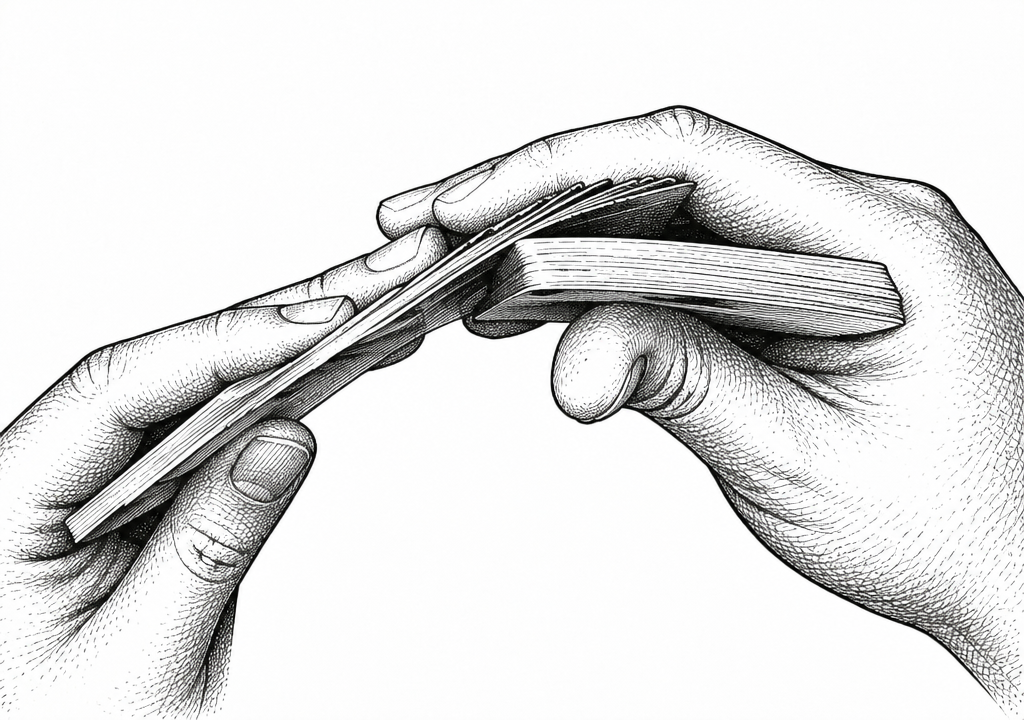
As you finish spreading through the deck, retain as many cards at the end as the value of the first spectator's Heart, and get a break above them. (In this example, since the card is the 7H, retain the last 7 cards; if it were the 3H, you would retain 3 cards.)
Square up the deck, cut those 7 cards to the face, and place the entire deck face down on the table.
"I placed a divination packet on the table earlier. Do you think it might contain the card you just remembered?"
Pick up the divination packet and spread it face up toward the spectators. Ask the first spectator; they will say yes. Turn to the second spectator and ask, "Your card isn't in here, is it?" They will say no.
Square up the divination packet and give it a false shuffle. Force the corresponding card (the 7H) on the first spectator using your preferred method. A simple method is to cut or shuffle the 7H to the bottom, hand the packet to the first spectator, and have them perform a Down-Under Deal.
Say: "I believe there is a hidden connection between choices made by the same person. You freely cut the deck earlier, and now you have chosen a card from this packet. What card did you remember?"
After the first spectator names their card, reveal the chosen 7H.
"Now, the 7 of Hearts has eliminated 1 card from our divination packet. Let's see if the remaining cards can tell us anything about the second spectator's card."
Have someone add up the values of the remaining 7 cards in the divination packet. The total is 29 (since 36 − 7 = 29).
Deal down to the 29th card in the deck. Turn it over to reveal the second spectator's card.
Afterthought
Many years ago, when I was in high school, I first read Simon Aronson's "Undo Influence" in Try the Impossible. At that moment, I immediately realized how extraordinary the principle was. It is one of the representative examples of the beauty of mathematical principles in card magic. For a long time, what I have liked and studied most in card magic has been various mathematical principles. So I immediately began studying this principle. I developed many applications and routines based on it, and I hope to share more of them with you in the future. This routine was one of the earliest applications based on the principle that I designed at the time. Even after all these years, I still like it, so I wanted to share it in my magazine.
Campagne pour le Numéro 2
Aidez-nous à atteindre 2 000 abonnés
Le magazine Cardmanship est actuellement entièrement gratuit et sans publicité. Lorsque notre compte Instagram (@albertcardman) atteindra 2 000 abonnés, le Numéro 2 sera également publié de manière totalement gratuite.